Wednesday, August 5, 2009

When life gives you rain... Play in it!!


Earlier this week it began raining while my friends and I were standing on the porch. But not one of us ran away. How many times do you get the chance to play in the rain? Not everyday right? So why not take the risk?

I was thinking....There was something so calm and soothing as if all my worries where being washed away. A feeling I used to get so long ago as I played in the rain while my mother would sit and watch.

As my friends were joking around... I thought to myself “why can’t we always go through life like this?” Why can’t we stay in the game, rain or shine. At times we give up on things because they get difficult, and we are too afraid to continue so we run away from it. It is when life gives you rain that you grow and learn. How else will you improve?

You can’t be afraid to fall or fail. If you do, you pick yourself back up and hope that you don’t fall again.

Have you ever played in the rain? Do you give up or stay in the game when things get difficult?


Moving towards positivity and possibility


Change starts with us; it starts within. I started Premium Hype Magazine out of a desire and a need to continually see positivity and positive progression. That external change begins internally. There’s a reciprocal relationship between people and culture; each shapes the other. However, culture only changes when the people interacting with that culture change. If we desire to see a more sustainable, positive, and progressive culture, we need to become sustainable, positive, and progressive people, individually and collectively.
In his Pedagogy of the Oppressed, Brazilian educator Paulo Freire argues that the fully human act upon and transform their world. He, at great length, discusses the cyclical nature of oppression as manifested via current pedagogies. Oppressed people oppress. Their idea of the fully human individual is their oppressor, so in an attempt to realize their full humanity, they become what they despised. Just like with oppression, there is a cyclical nature to negativity, positivity, and possibility. Negativity begats negativity, positivity begats positivity, and possibility begats possibility.

As evidenced by the several converging crises the world is faced with, we cannot maintain a wistful and passive desire for change. We cannot assume that change is impossible and do nothing. We cannot maintain the cynical “search and destroy” perspective that offers nothing of constructive value. We must be intent on finding the good. It has to be a continuous action that infiltrates every area of our lives. We must also become those who create the good. Those that inspire, that connect, comfort, heal, and transform into an even greater and grander version of ourselves than we thought was possible. Because it is possible.

There is commonly a disconnect between who we want to be and who we are. Please take time to seriously investigate who you’d like to be, who you are, and what you can do to bridge the gap. Live by your ideals.




Soooo.. Why do People write?


It’s a question every writer asks themselves, either in the midst of sorting through overdue bills, during the dead hours of a suffocating block, or upon receipt of another rude rejection: why do I do this? Ta-Nehisi Coates, who discussed the subject with Premium Hype, recently posted about the unhappy vocation and has been leading many bloggers to engage in writerly soul searching. Is good writing a product of endless practice, God-given talent, or is it something else altogether?
Mr. Strauss suggest that writing does require an inherent trait, but it isn’t talent: it’s the inability to stop writing. It’s hard to argue that that’s not part of the mix, but as the editorial assistant tasked to read many massive novels of somehting less than quality, there’s more involved. Not every hypergraphia sufferer becomes worth reading, even if they get published.

Billy Collins offered Premium Hype a unique perspective on the question: writers, and artists in general, are people who retain the unfettered brilliance and creativity of their childhood throughout their lives. Modern workshops and competitive structures, he claims, do more harm than good. In fact, he claims, what writers need is less production and more confrontation with the blank page.

What do you believe are the traits that all successful writers share?


Being happy is... bad?


If you hope to live a really, really long life, turns out it’s better to be conscientious than optimistic. As The Daily Beast reports, Psychologists have created something called the “Big 5,” a criterion used to comprehend a human’s personality. The five aspects areagreeableness, openness, extroversion, conscientiousness and neuroticism, with each given a ranking to form a personality understanding. The more conscientious a person, the longer he or she is likely to live. So, wipe that smile off your face and get to work!


Tuesday, August 4, 2009

The Science of Happiness


How happy are you, on a scale of 1 to 10? If you don’t know how to answer that, you’re not alone. Surveying people about their happiness is notoriously problematic, even for psychologists. It requires researchers to reach some definition of the term that matches how their research subjects define it, and for people to self-report honestly, which is always a crapshoot. Still, surveys of the world’s happiest countries pop up all the time, but some researchers have devised what they call a more rigorous way to sense the national mood.
The New York Times reported today on an attempt by University of Vermont researchers to study American happiness not by asking Americans how happy they are, but rather by what we say to each other through speeches, blog posts, and song lyrics. These are more honest measures of well-being, they say, free from the self-censorship that survey subjects impose in order to seem “normal” to the person in the white coat with the clipboard.

The Vermont scientists compiled their findings by analyzing more than 200,000 song lyrics and more than 2 million blog posts, and rating their happiness content from 1 to 10: 1 being total misery, 10 jubilation. Some of the findings weren’t too surprising—teens were angsty, people over 70 worried about illness, and the rest of us are apparently too busy working to escape emotional mediocrity.

The real question is, how much can you take from analyzing speeches, songs and blogs? The Vermont study confirmed a lot of things we already knew, like that the nation was sad on Sept. 11 and happy when Obama was elected President, lonely on Valentine’s and feeling guilty for overeating and overspending at Christmas. However, national well-being is just an average. There were certainly people who weren’t happy when Obama won the election, and who were terribly happy last Valentine’s Day.

This study technique might very well lead to interesting derivatives when researchers get the chance to slice and dice the data some more. But enough about the psychological state of the nation—it’s a tool for pointless lists and meaningless comparisons between countries, not a useful metric.


A Real Estate rebound?!


More encouraging news has flooded the real estate sector as the National Association of Realtors recently reported that home resales increased by a better-than-expected 3.6% in June. This pushed purchases to an annual rate of 4.89 million, but does this mean that housing has bottomed out and is in rebound mode?

This most recent outperformance was primarily driven by the following 3 factors: the federal government’s tax incentives to first-time homebuyers, low prices caused by the surge in foreclosures, and relatively low borrowing costs.

These driving forces are a far cry from the driving forces that are needed for a rebound -- namely, a surge in demand and the ability for consumers to obtain mortgage loans.

Home inventories are at all-time highs, consumers are saving and deleveraging wealth, consumer debt numbers are skyrocketing, unemployment rates continue to rise, and those that do have jobs are witnessing negative wages. Until these issues are addressed, it's very difficult to say that a bottom in the real estate markets has been hit.

Regardless, the sector has seen a nice uptrend, as seen in the performance of the following equities:

1. iShares Dow Jones US Real Estate Index (IYR), which saw a March low of $22.21 to bounce back nicely and close at $33.15 on July 22, an increase of 49%.

2. SPDR S&P Homebuilders (XHB) rebounding nicely to close at $12.89 on July 22 from a March low of $8.25, a jump of 56%.

3. Equity Residential (EQR), up 24% after witnessing a March low of $16.71 to close at $20.71 on July 22.

4. HCP Inc. (HCP) which saw a March low of $16.08, has gained 43% since then, to close at $22.92 on July 22.

If one does consider playing the real estate sector, keep in mind the risk involved with doing so. To mitigate these risks, an exit strategy utilizing stop losses is key. According to the latest data from www.SmartStops.net, the upward trend in the previously mentioned equities might be coming to an end at the following price points: IYR at $31.48; RTH at $78.36; EQR at $19.42; HCP at $21.76. Keep in mind that these triggers change as the markets fluctuate.


The power of Positive thinking!

Positive thinking is a mental attitude that admits into the mind thoughts, words and images that are conductive to growth, expansion and success. It is a mental attitude that expects good and favorable results. A positive mind anticipates happiness, joy, health and a successful outcome of every situation and action. Whatever the mind expects, it finds.


Not everyone accepts or believes in positive thinking. Some consider the subject as just nonsense, and others scoff at people who believe and accept it. Among the people who accept it, not many know how to use it effectively to get results. Yet, it seems that many are becoming attracted to this subject, as evidenced by the many books, lectures and courses about it. This is a subject that is gaining popularity.

It is quite common to hear people say: "Think positive!", to someone who feels down and worried. Most people do not take these words seriously, as they do not know what they really mean, or do not consider them as useful and effective. How many people do you know, who stop to think what the power of positive thinking means?


Word of advise...


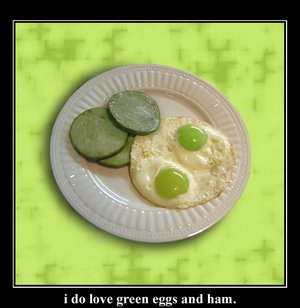
when less is more…the story behind dr. seus’ green eggs and ham


Bennett Cerf, Dr. Seuss’ editor, bet him that he couldn’t write a book using 50 words or less. The Cat in the Hat was pretty simple, after all, and it used 225 words. Not one to back down from a challenge, Mr. Geisel started writing and came up with Green Eggs and Ham – which uses exactly 50 words.

The 50 words used are:a, am, and, anywhere, are, be, boat, box, car, could, dark, do, eat, eggs, fox, goat, good, green, ham, here, house, I, if, in, let, like, may, me, mouse, not, on, or, rain, Sam, say, see, so, thank, that, the, them, there, they, train, tree, try, will, with, would, you.


Some people....

There are some people who live in a dream world, and there are some who face reality…AND THEN there are those who turn one into the other…which one are you???